Energy recovery ventilators (ERVs) help replace stale indoor air with fresh outdoor air while reclaiming heat or coolness. This guide highlights five top ERV/HRV options, focusing on models with solid energy efficiency, smart features, and reliable filtration. Read on to compare features, installation considerations, and how these units perform in different climates.
| Product | Brand | Key Feature |
|---|---|---|
| Weiworld Heat Recovery Ventilator | Weiworld | High-efficiency ceramic heat exchanger with WiFi/remote control |
| Broan B230H75RT AI Series | Broan-NuTone | VIRTUO technology for airflow verification and auto-balancing |
| Panasonic Intelli-Balance 100 ERV FV-10VEC2 | Panasonic | 2 DC/ECM motors, customizable 30–100 CFM, temp climate suitability |
| Panasonic Intelli-Balance 100 ERV FV-10VE2 | Panasonic | Temperate climate model, boost function, Min/Hr timer |
| Broan B230H75RT AI Series | Broan-NuTone | HRV-focused model for improved indoor air quality |
Note: This selection emphasizes models with reliable filtration, energy-efficient cores, and user-friendly controls suitable for American homes. Each product includes its own installation considerations, to help you decide which unit matches your climate, home size, and desired level of automation.
Weiworld Heat Recovery Ventilator
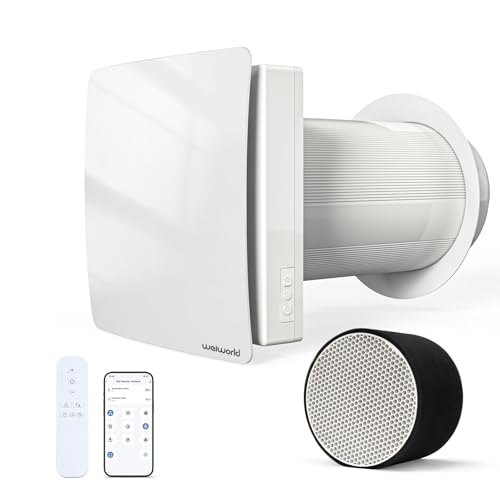
The Weiworld model integrates a high-efficiency ceramic heat exchanger that recovers up to 90% of heat energy from exhaust air. This improves indoor air quality while reducing heating energy use. Smart features include WiFi and remote control via Tuya App, enabling you to adjust fan speeds, humidity, and modes from anywhere. It offers three airflow modes—Fresh Air, Exhaust, and Recirculation—allowing flexible operation to balance comfort and energy savings in homes, attics, or garages.
Broan B210E75RT AI 206 CFM ERV

The Broan B210E75RT AI 206 CFM ERV emphasizes automated airflow management through VIRTUO technology, which verifies and balances airflow automatically. This reduces installation complexity and helps maintain the intended performance. The unit provides tempered outdoor air supply while exhausting stale indoor air, contributing to better indoor air quality and comfort across various living spaces. It is designed for straightforward set-and-forget operation once properly installed.
Panasonic Intelli-Balance 100 ERV FV-10VEC2

This ERV balances moist and fresh outdoor air while maintaining indoor pressure. The cold climate version supports temperatures down to -22°F (-30°C). It includes a MERV 8 filter and dual DC/ECM motors with a Pick-A-Flow selector for adjustable 30–100 CFM, plus a Boost function to quickly reach 100 CFM. The Min/Hr timer enables precise run-time control for energy efficiency. It is well-suited for homes in colder climates seeking reliable heat recovery and flexible control.
Panasonic Intelli-Balance 100 ERV FV-10VE2

The temperate climate variant of the Intelli-Balance 100 ERV supports similar core features with a focus on environments with milder winter conditions. It includes a MERV 8 filter, dual DC/ECM motors, and the Pick-A-Flow selector (30–100 CFM) with a Boost function and Min/Hr timer. This model suits houses in temperate regions where energy efficiency and air quality are priorities but extreme cold is less of a concern.
Broan B230H75RT AI Series 230 CFM HRV
The Broan B230H75RT AI Series focuses on rapid airflow verification and auto-balancing to achieve consistent results across dwelling types. While designed for HRV operation, it contributes to improved indoor air quality through tempered outdoor air supply while exhausting stale air. VIRTUO technology supports a simplified installation experience, helping ensure the system settles into a healthy initial configuration for various home layouts.
Buying Guide: Key Purchase Considerations And Comparisons
Choosing the right ERV or HRV involves matching your home’s climate, size, and existing HVAC setup. Consider the following perspectives and comparisons to guide your decision:
- Climate suitability: Cold-climate models excel at maintaining warmth while exchanging air, whereas temperate models are balanced for moderate winters. If you live in areas with extreme cold, prioritize units with robust cold-weather performance and reliable filtration.
- Filtration: A higher MERV rating can improve indoor air quality by capturing fine particles, but it may also impact airflow. Select filters that balance filtration efficiency with the unit’s airflow capacity (CFM).
- Energy recovery core: Ceramic heat exchangers and other high-efficiency cores maximize heat recovery, reducing energy bills. Compare recovery rates and the ability to reclaim heat from exhaust air.
- Controls and smart features: WiFi-enabled control, remotes, and timer options provide convenience and better resource management. Consider whether you prefer app-based control or on-device controls.
- Installation complexity: Some models offer auto-balancing and airflow verification to simplify setup. If you’re replacing an existing unit, check compatibility with your current ductwork and mounting options (wall-mounted vs. ceiling-mounted).
- Ventilation modes: Fresh air, exhaust, and recirculation modes affect how air moves in your home. Ensure the unit supports the modes you need for seasonal changes and occupancy patterns.
- Maintenance: Filter replacement frequency and ease of service are practical considerations. Models with readily accessible filters save time and effort.
- Noise levels: Higher CFM settings can generate more noise. Look for units designed to minimize sound output at typical operating speeds.
- Energy impact: An ERV/HRV should lower overall energy use by recovering heat or coolness. Compare rated energy savings against your home’s energy profile to quantify benefits.
In summary, the best ERV/HRV choice depends on climate resilience, filtration needs, and the level of automation desired. The models listed above provide a mix of smart features and robust cores, allowing homeowners to tailor ventilation to comfort and energy efficiency.