When you need extra frozen storage without sky-high energy bills, choosing a compact, energy-efficient chest freezer matters. This guide highlights five reliable options that balance capacity, quiet operation, and efficient cooling. Each picks helps you maximize space in apartments, garages, or basements while keeping electricity usage low.
| Product | Brand | Capacity | Energy Feature |
|---|---|---|---|
| EUHOMY 3.5 Cu.Ft Chest Freezer | EUHOMY | 3.5 Cu Ft | Low-noise compressor, ~0.53 kWh/day |
| BLACK+DECKER 2.0 Cu. Ft. Chest Freezer | BLACK+DECKER | 2.0 Cu Ft | Energy-efficient cooling with compact footprint |
| EUHOMY 3.5 Cu.Ft Chest Freezer (Removable Basket) | EUHOMY | 3.5 Cu Ft | 7-stage thermostat, energy-conscious design |
| Igloo 3.5 Cu. Ft Chest Freezer | Igloo | 3.5 Cu Ft | Efficient D-Type refrigeration with tight seal |
| Kismile 3.5 Cu. Ft Chest Freezer | Kismile | 3.5 Cu Ft | 7-grade thermostat, low energy consumption |
EUHOMY 3.5 Cu.Ft Chest Freezer with Wheels

The EUHOMY 3.5 Cu.Ft Chest Freezer combines a compact footprint with practical mobility. With dimensions of about 21.5″(W) x 18.7″(D) x 32.7″(H), it fits tight corners in apartments or dorm rooms. It includes a small mesh basket for organized storage and a drainage port to simplify cleanup after power outages. A bottom-running wheel system lets anyone reposition the freezer with ease. A high-efficiency R600a compressor claims energy use around 0.53 kWh per day and an 12-hour freezing capacity of roughly 24 pounds, while the insulation and door seal minimize temperature exchange. Noise stays around 38 dB, making it suitable for shared living spaces.
EUHOMY 3.5 Cu.Ft Chest Freezer With Removable Basket

This version mirrors the 3.5 cu ft capacity but emphasizes a removable basket and a 7-stage adjustable thermostat. The compact 3.2 ft² footprint fits tight kitchen corners or laundry spaces. The 7-stage thermostat offers precise control across a temperature range that accommodates chicken, beef, and seafood. The same energy-focused design uses a quiet, low-noise compressor, foam insulation, and an insulated door seal to slow temperature exchange during outages.
BLACK+DECKER 2.0 Cu. Ft. Chest Freezer
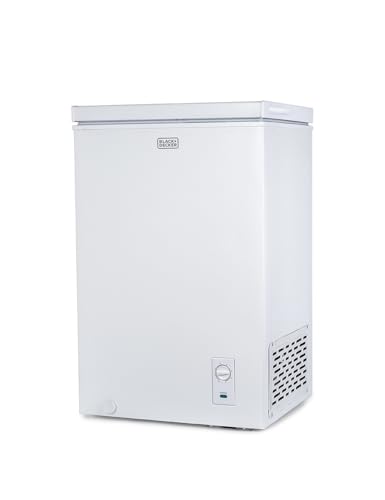
Designed for compact spaces, this 2.0 cu. ft. chest freezer adds deep storage without crowding your room. It supports up to approximately 70 pounds of frozen items and includes a removable storage basket to help with organization. The model emphasizes efficient operation for basements, garages, or apartments, making it a practical choice when extra freezer space is needed without a large energy footprint.
Kismile 3.5 Cu. Ft Chest Freezer

The Kismile freezer offers a compact 3.5 cu ft capacity with 7-grade thermostat control. Its footprint (about 21.26″ x 21.65″ x 30.91″) makes it suitable for kitchens, dorm rooms, or offices. The unit emphasizes energy efficiency with a low-consumption compressor and noise levels under 40 decibels. The 7-stage thermostat allows freezing temperatures from near 7.6°F to -7.6°F, enabling flexible storage for meats, dairy, and prepared foods.
Buying Guide: Energy Efficiency Front Of Mind
- Size and footprint: Choose a model that fits your available space while offering adequate internal capacity. Compact chest freezers with efficient insulation can store a similar amount as larger units.
- Thermostat control: Models with multi-stage or adjustable thermostats help maintain precise temperatures, reducing energy use and preserving food quality.
- Compressor type and seal: High-efficiency compressors (often R600a) paired with well-sealed doors reduce energy consumption and minimize temperature fluctuations.
- Noise level: If the freezer sits in a living area, aim for units spec’d below 40 dB for quiet operation.
- Mobility and defrost method: Freezers with wheels or casters simplify moving for cleaning or repositioning. Manual defrost units may require more maintenance, while frost-free or drain-equipped models ease upkeep after outages.
- Organization features: Removable baskets and internal dividers help maximize storage and reduce energy use by avoiding overpacking, which can impede airflow.
- Outage resilience: Look for foam insulation depth and door seals designed to delay warming during power interruptions.
- Durability and warranty: Consider build quality, material durability, and warranty length, especially for frequent access in kitchens or garages.
Across these selections, the focus remains on energy efficiency without sacrificing usable capacity. For small living spaces, opting for a 3.5 cu ft model with a well-sealed door and a quiet compressor typically delivers the best balance of performance and electricity use. In slightly larger setups, a 7.0 cu ft chest freezer can provide substantial capacity with manageable energy costs if it employs modern, efficient refrigerants and a good insulation envelope.